


Plastic Food Packaging:
The Basics
Nowadays, plastic food packaging plays a vital role in preserving, protecting and presenting food products. The fundamentals of plastic food packaging are to protect the food while ensuring the safety and integrity of the contained items.
The versatility of plastic food packaging makes it an optimal choice for storing meals, with many applications across various food sectors. Depending on the required plastic food packaging needs, there are many materials for the right usage.
Plastic food packaging can also be designed for recycling when the material and packaging design are compatible with relevant collection, sorting and recycling systems.
Ready more about plastic as a material here.

PLASTIC FOOD PACKAGING
DESIGNED FOR RECYCLING
As part of Plus Pack’s approach to circularity, we focus on plastic food packaging designed for recycling. Important factors when designing plastic packaging for recycling include:
- Mono-material design
- Material and colour compatible with relevant sorting systems
- Packaging design compatible with relevant recycling streams
Recycled content can be considered separately when selecting the packaging material.
Plastic food packaging can protect food while also being designed with sorting and recycling in mind. Actual recycling depends on the complete packaging design and the collection, sorting and recycling systems available in the relevant market.
Extended Producer Responsibility (EPR) schemes may also differentiate packaging fees based on specific design and recyclability criteria. Read more about our approach to circularity here.
Exploring Non-Plastic
Food Packaging Alternatives
Plastic food packaging may not always be the right solution for your packaging needs. When exploring non-plastic food packaging solutions, aluminium could be the right alternative for you. Unlike plastic, aluminium can be recycled forever without the loss of quality. Making aluminium a material that can contribute to a circular economy. Aluminium as a non-plastic food packaging material provides a robust and versatile storage solution for food that can go from freezer or fridge to microwave oven, oven or on the grill.
One of Plus Packs aluminium solutions is our popular Ready2Cook® range , often used for warm ready meals and widely recognized for its simple, elegant design.
See this non-plastic food packaging solution here.
Can circular plastic packaging balance
convenience and environmental impact?
We receive many requests about circular plastic packaging and how environmental considerations can be balanced with convenience. Rather than describing packaging as sustainable, we focus on specific characteristics such as mono-material design, recycled content and packaging designed for recycling.
To understand circular plastic packaging, it can be helpful to compare it with a linear economy. In a linear model, materials may be discarded after use. Packaging designed for recycling aims to support keeping materials in circulation where suitable collection, sorting and recycling systems are available. Reuse is relevant for packaging specifically designed and tested for repeated use. Different plastic materials and formats can be selected to suit specific product and convenience needs.
Read more about circular plastic packaging here.
Lightweight Plastic Packaging:
Efficiency in Transport and Handling
Lightweight plastic packaging is essential in a circular economy where the goal is to optimize materials and minimize resource usage as much as possible. Using lightweight plastic packaging involves downgauging – or lightweighting - which has multiple benefits. Firstly, it conserves the planet’s resources by using less material. Secondly, it optimizes handling and transportation processes, which cuts costs and reduces carbon emissions.
Additionally, downgauging aligns with the 2025 implementation of Extended Producer Responsibility (EPR) schemes on packaging with associated recycling fees. By adopting downgauged lightweight plastic packaging solutions, not only can you lower recycling fees but also contribute to reducing environmental footprint.
Custom Plastic Food Packaging:
Customized Solutions for Your Food
Are you looking for packaging solutions that are just right? We have many years of experience in designing and producing customized plastic food packaging solutions. We understand the complexity of finding the right solution, in terms of needs, requirements and demands.
Our design team can give you the guidance that you need for customized plastic food packaging. By designing customized plastic food packaging in close collaboration with customers, we can ensure that every aspect of the tray is optimal and fits the specific needs, in terms of material, price and logistics.
See here how we can customize your next packaging solution here.

Plastic Packaging for Food Products
Ensuring Freshness and Safety
When it comes to keeping our food fresh and safe, plastic packaging for food products is a reliable choice. It is designed to protect food from containers and maintain its quality until it reaches the consumer. Plastic packaging for food products is also a key player in keeping food fresh for longer, meaning extended shelf life, which helps minimize food waste. By using plastic packaging for food products, design and circularity are in focus.
Understanding the Types of Plastic
Used in Food Packaging
There are two different types of plastic used in food packaging that are optimal materials. These are PP and PET, which are both types of plastics used in food packaging solutions. PP is a widely used thermoplastic known for its strength. One of our popular PP packaging solutions is our Bistro range, offered in clear and colored with a variety of uses.
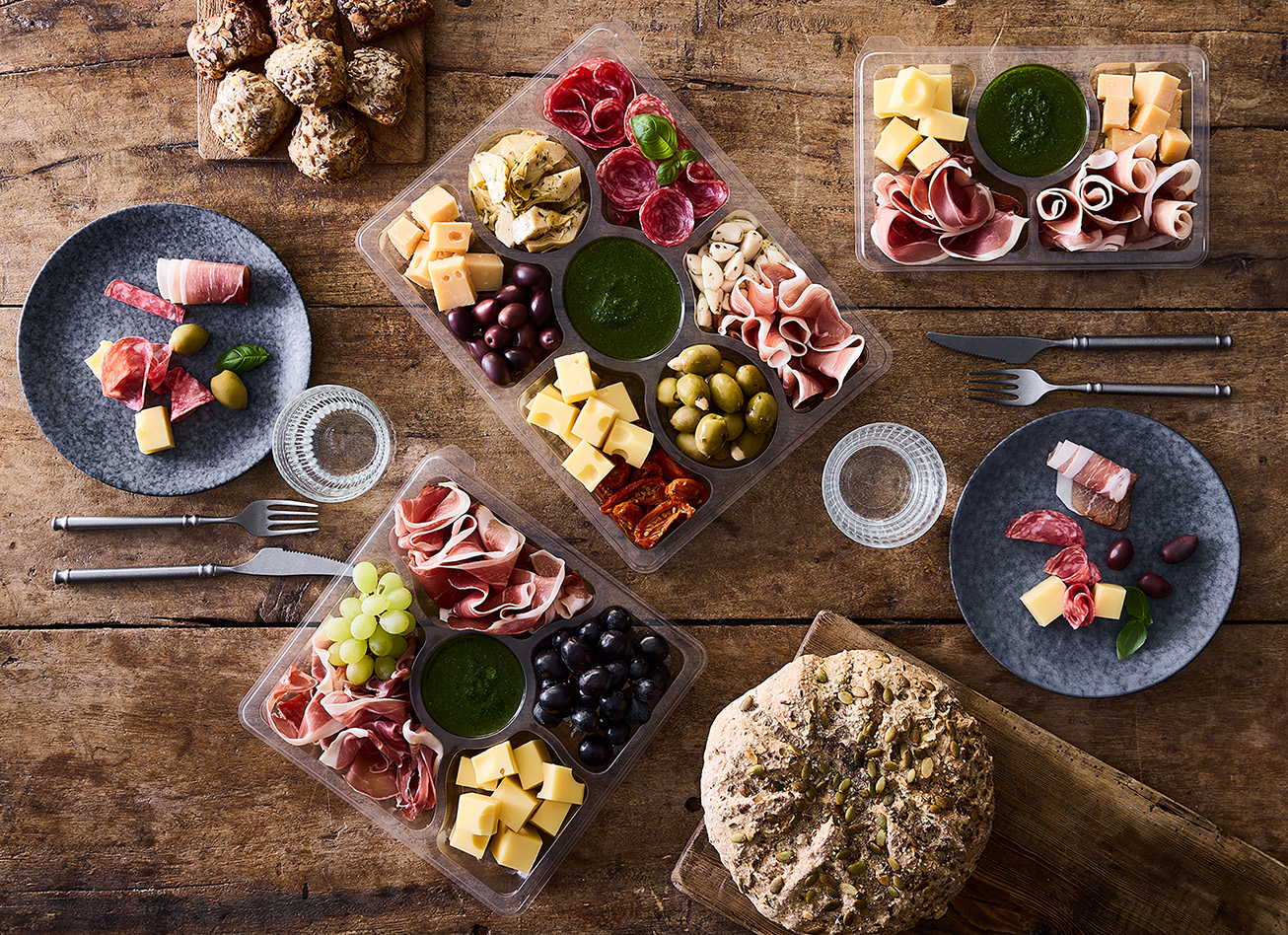
PET is the most widely used plastic globally, especially in food packaging that needs a clear look like for fresh salads, fruits, cold meats, snacks and more. PET is easy-to-recycle and comes in 4 different types APET (amorphous PET), CPET (crystalline PET), DPET (direct-to-sheet), and rPET (recycled PET). Our popular Zen Selection platter, designed for social eating, is a recyclable plastic food packaging offered in 3 sizes with 3, 5 or 7 compartments.
See the different ranges here.